You’re not going to want to believe this. It doesn’t feel like it should be true. But it is: The A20 Pro in the iPhone 18 Pro is legitimately faster than a standard M4 as found in the recent Mac mini, or current iPad Air or iMac.
That’s right. Faster. And not just “sort of faster in just this one test when you run in one specific way.” Faster overall. Faster generally.
Yes, of course there are caveats, and we’ll get to those. But as defensible claim, we can say that Apple’s advancements in chip design and manufacturing processes have now made the iPhone in your pocket faster than the entry-level desktop computers they were selling just two years ago. Crazy, right?
CPU performance
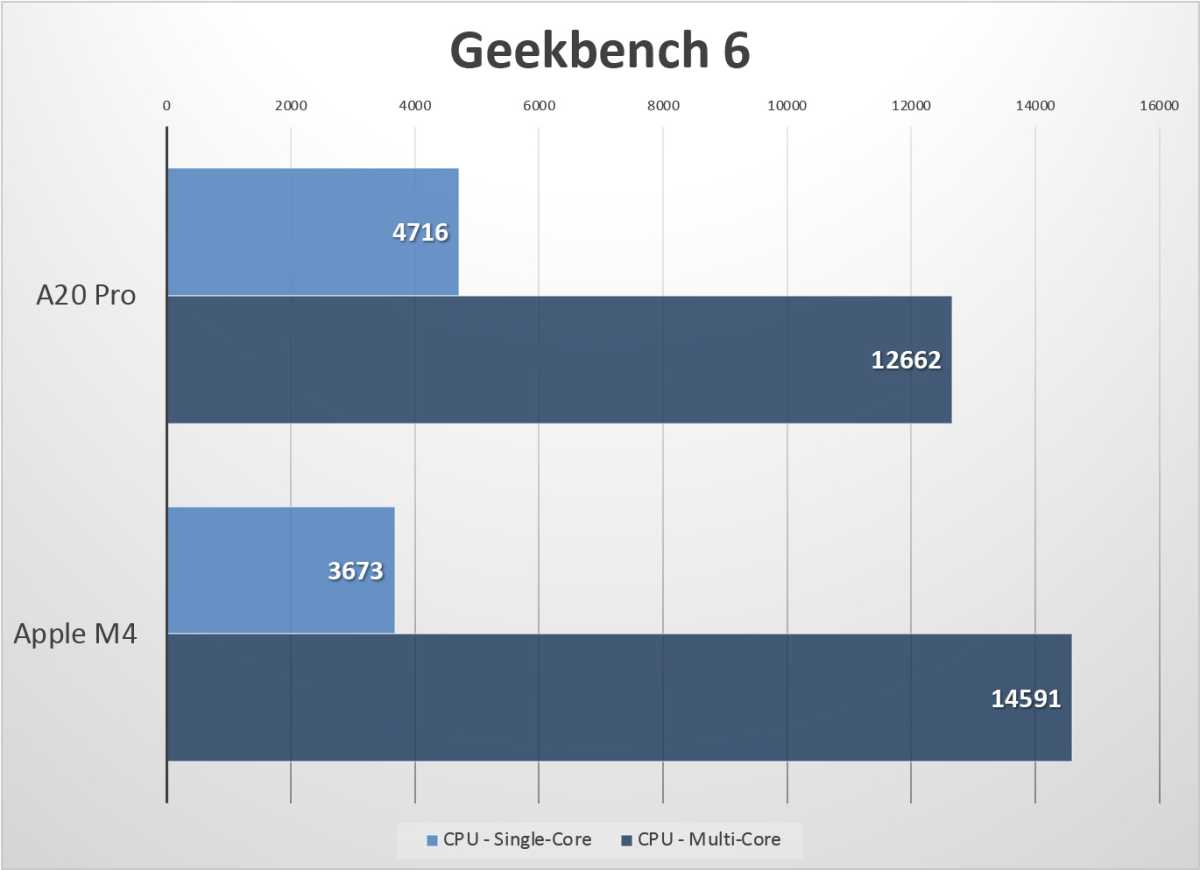
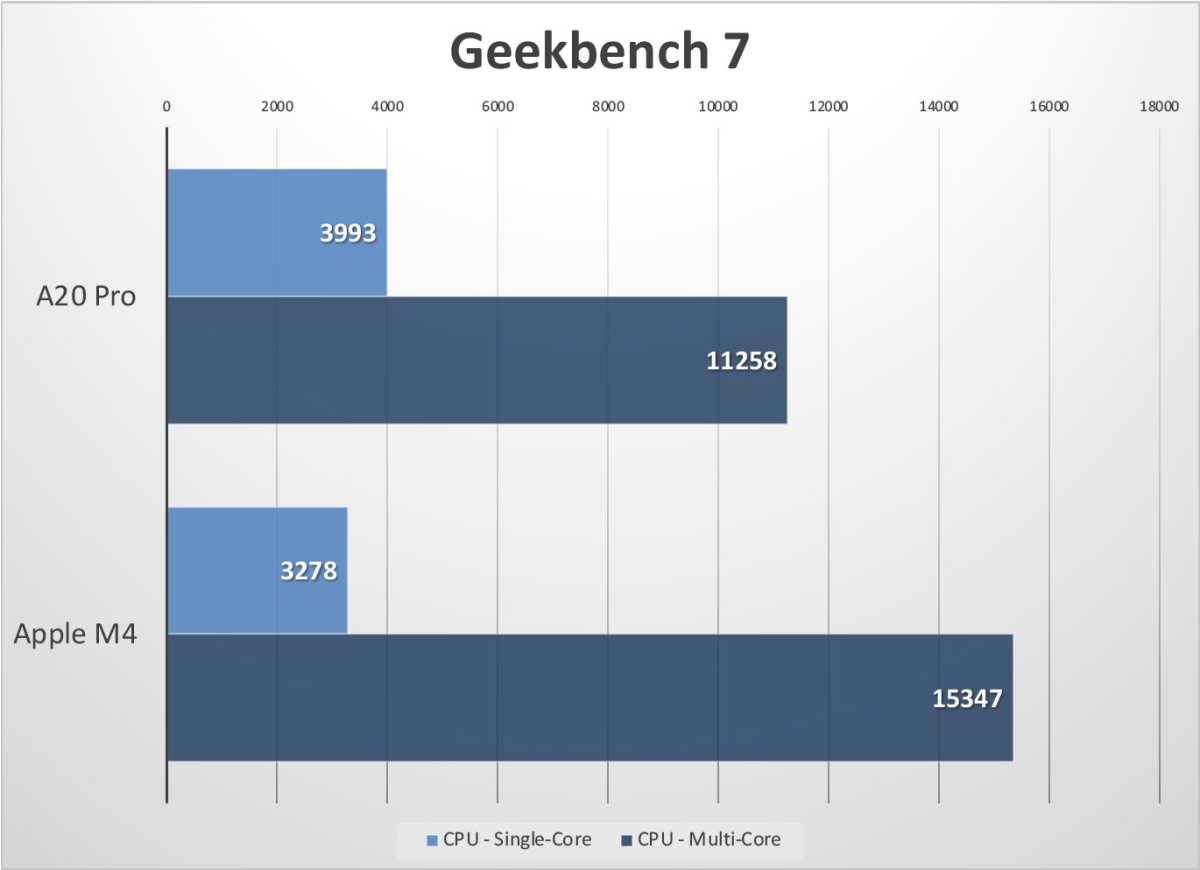
If there’s a place to equivocate about a “faster” claim, it’s in the CPU performance. Let’s take a look at Geekbench 6 and Geekbench 7 numbers. The M4 numbers here are from a Mac mini with the full 10-core CPU and 10-core GPU.
Foundry
Apple called the two big super cores in the A20 Pro “desktop class” and it’s hard to argue when the single-core performance is 28 percent higher than the M4. But the M4 has 10 cores and the A20 Pro has 6, so it’s just got too big an advantage in multi-core processing. Still, it’s only 13 percent faster despite having more cores to work with.
Foundry
The newer Geekbench 7 scores, with represent more strenuous and modern workloads, tell a similar story. Single-core performance of the little computer in your pocket is 22 percent higher than the bigger computer on your desk. The multi-core benefit of the M4 is about 27 percent here, despite having 67 percent more cores.
So yes, multi-threaded performance and multitasking on the M4 will be faster than the A20 Pro, for tasks that heavily utilize all the CPU cores. But for any task that is limited by the performance of a single thread (which are quite common), the A20 Pro is quite a bit faster than the M4.
GPU performance
Modern computing platforms rely in GPU performance as much as CPU performance, perhaps even more so. Does the M4 hold an advantage there? Nope!
Foundry
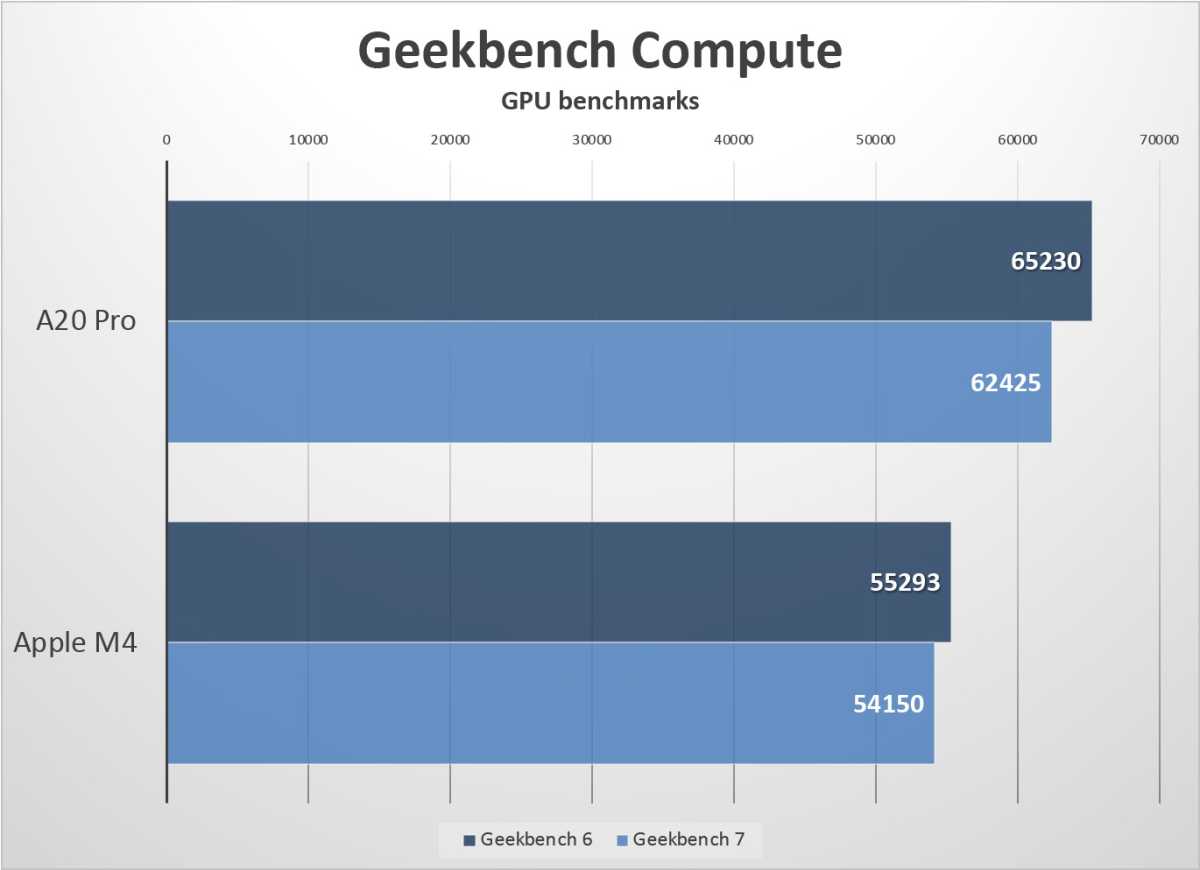
The Geekbench GPU compute tests measure the GPU’s ability to do computational tasks like face tracking, image upscaling, or particle physics simulation. Whether it’s the older Geekbench 6 test or the newer Geekbench 7 test, the A20 Pro is 15-28 percent faster than the M4. This is despite only having 7 GPU cores to the M4’s 10 cores, and slightly less memory bandwidth (about 115 GB/s to 120 GB/s). Architectural changes really matter!
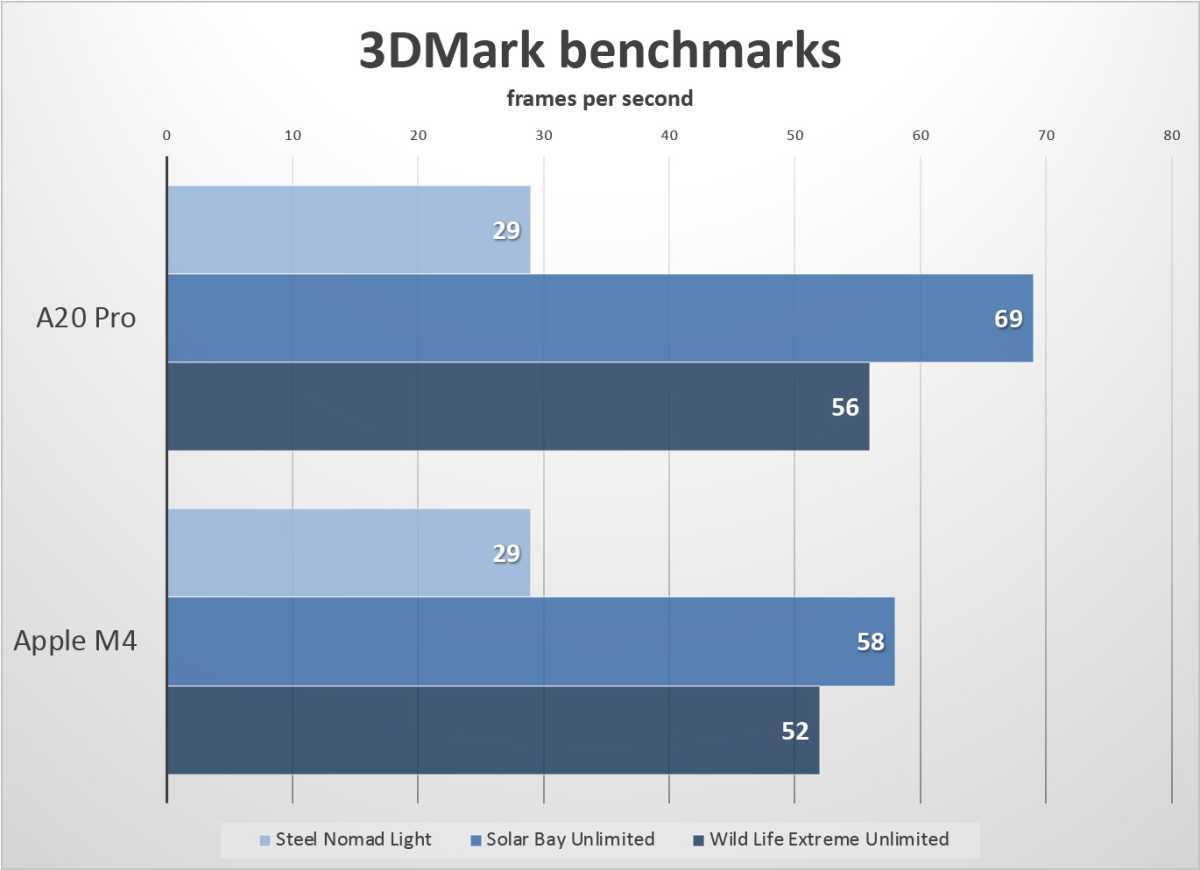
For a look at actual 3D graphics rendering performance we’ll turn to 3DMark. Not all these tests are available on the Mac, so for some of these scores we’ll turn to the M4 iPad Pro, using the same 10/10 core configuration as the Mac mini.
Foundry
The most strenuous test with no ray-tracing, Steel Nomad Light, is a tie. For everything else, the A20 Pro is significantly faster. Solar Bay Unlimited, which has significant ray tracing demands, is 19% faster on the mobile chip. The older Wild Life Extreme Unlimited test, which uses older graphics techniques and no ray tracing, is still just slightly faster (8%) on the A20 Pro.
It’s kind of crazy. Apple’s new iPhone chip, with 7 GPU cores and ~115 GB/s of memory bandwidth, is outclassing its entry-level desktop chip from two years ago despite the fact that it has 10 GPU cores and ~120 GB/s of memory bandwidth. This is for both compute and 3D graphics rendering.
AI performance
There aren’t a lot of good AI tests for both mobile and desktop, but the Geekbench AI suite lets us run through a bunch of AI/ML inferencing tasks using the CPU, GPU, or Neural Engine.
Foundry
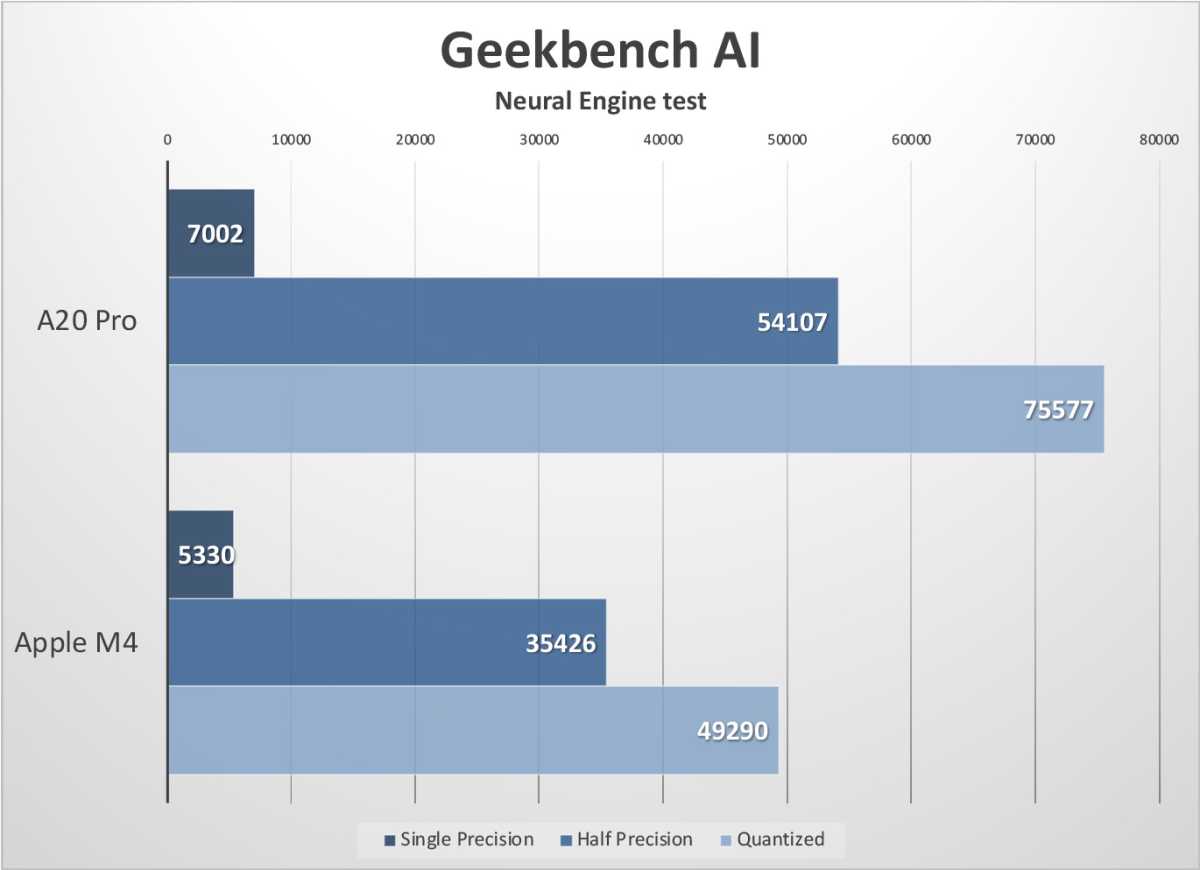
Apple doubled the Neural Engine in the A20 Pro (and M6) to 32 cores, and it really pays off. Single-precision workloads are more than 30 percent faster, and half-precision or quantized tasks (most common for consumer AI applications) are 53 percent faster.
That’s about 50 percent higher AI performance on the latest iPhone compared to a Mac mini or iMac from just two years ago.
But not all AI workloads run only on dedicated neural processing units. It’s common for GPU hardware to work on AI tasks, so let’s see what happens when we run the same tests using the GPU.
Foundry
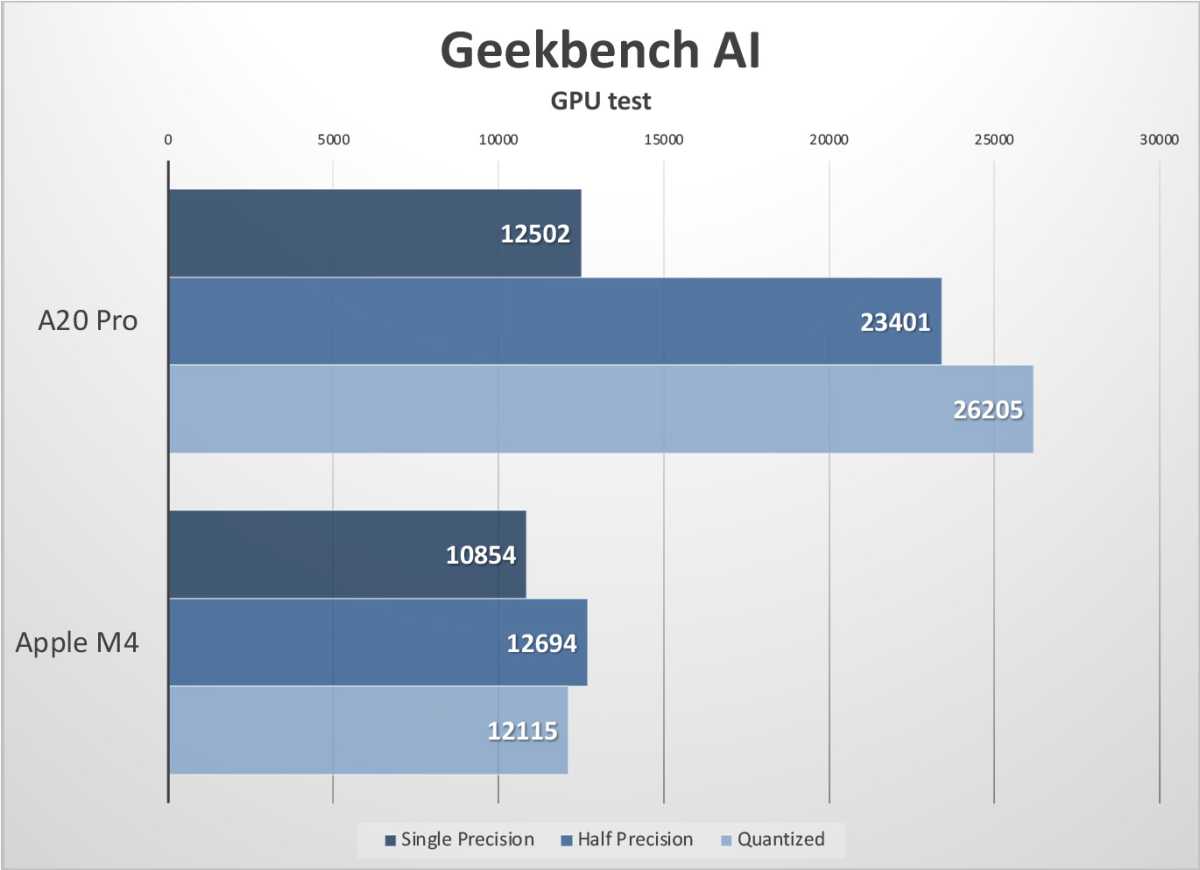
It’s a bloodbath. Single-precision tasks are “only” 15 percent higher, but half-precision task are a whopping 84 percent faster using the A20 Pro’s GPU than the M4’s GPU. Quantized operations are more than twice as fast—116 percent faster to be exact!
Apple added hardware to the GPU cores to specifically accelerate AI tasks in the A19 Pro and M5 generation, and of course that carries onto the A20 Pro. They obviously make a huge difference, because you’re seeing less cores and memory bandwidth on the iPhone 18 Pro deliver twice the performance as an M4 Mac.
The fine print
While it’s entirely defensible to call the A20 Pro “faster than the M4,” and we have the receipts to prove it, we’d be remiss not to mention a few caveats.
First, the Macs and iPhones have different operating systems that are made to be used differently, so your actual productivity on an M4 Mac won’t be lower just because the chip has lower benchmark scores. Also, nearly any Mac will have better cooling performance than an iPhone 18 Pro. So while these benchmarks are accurate for short bursts of performance, you can put your thumb on the scale in favor of the M4 Mac for long tasks where things get hot (though we still imagine the iPhone 18 Pro would win in many cases).
And finally, we’re not comparing Apple’s latest iPhone chip to its latest Mac chip. The M4 was first introduced about two years ago, in late 2024. But until just recently, the M4 was the entry-level chip for the Mac mini. It only just got replaced in the Mac mini and it’s still the only chip you can get in an iMac.
Just imagine what a MacBook Neo would be like with an A20 Pro inside. We suspect that laptop will be updated in 2027, but it will probably get an A19 Pro, as the current model has an A18 Pro. That means an A20 Pro-packing MacBook Neo isn’t likely to happen until 2028.