By 1215, England had reached a point where opposition to King John was no longer a collection of private grievances among a handful of dissatisfied nobles. Years of military failure, heavy taxation, arbitrary government and disputes with the Church had steadily eroded confidence in the king. The loss of Normandy and much of the Angevin Empire had damaged John’s prestige, while his repeated demands for money to finance further military campaigns placed an increasingly heavy burden upon his subjects. For many of the barons, the question was no longer simply whether John was a successful king. It was whether his authority could continue without restraint.
Terry Bailey explains.
You can read part 1 on the cruel King who made his own enemies here, and part 2 on losing an empire here.
The 1225 version of Magna Carta issued by Henry III of England. Source: Public domain, National Archives, available here.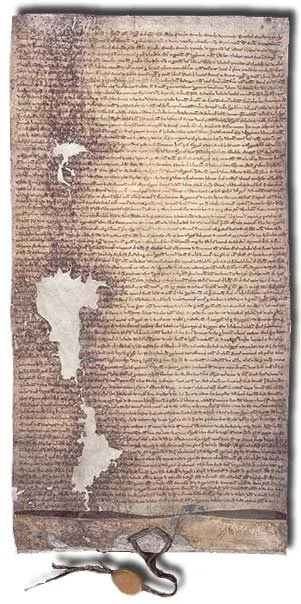
.jpg)
The rebellion that emerged was therefore organized rather than spontaneous. A group of powerful barons formed a coalition against John, coordinating their demands and presenting a united political front. They were not attempting to abolish the monarchy, nor were they seeking to produce a modern democracy. Their objective was to force the king to recognize that even a monarch was subject to established law and custom. In medieval England, this was a revolutionary proposition in practice, even though the rebels themselves largely expressed their demands in terms of restoring traditional rights.
The rebels understood that military pressure alone might not be enough. They needed to demonstrate that John could no longer govern effectively without their cooperation. Their campaign therefore combined armed resistance with political organization. When negotiations failed, the barons moved against royal strongholds and eventually seized London in May 1215. The capture of the capital was a decisive turning point. London was not merely England’s largest and most important city; it was a center of royal finance, administration and trade. Its loss placed enormous pressure upon John and demonstrated that the rebellion had become a national political crisis.
With London in rebel hands, John was forced to negotiate. The king and the barons met at Runnymede, a meadow beside the River Thames, in June 1215. The negotiations were difficult, and neither side entirely trusted the other. The barons wanted enforceable guarantees that John would respect their liberties, while John wanted to preserve the authority of the Crown. The resulting document, eventually known as Magna Carta, was therefore not a declaration of democracy but a negotiated attempt to prevent the kingdom from descending further into civil war.
Magna Carta was sealed by John on 15 June 1215. Its immediate purpose was practical: to settle the dispute between the king and the rebel barons. Yet the document contained principles whose significance would eventually extend far beyond the circumstances in which it was produced. It established the idea that the king’s authority was not unlimited and that royal government should operate according to recognized law and custom.
One of the earliest provisions concerned the Church. Magna Carta declared that the English Church should be free and possess its liberties unimpaired. This reflected the bitter struggle between John and the papacy that had dominated part of his reign, but it also reinforced the broader principle that the king could not simply treat every institution within his kingdom as an extension of his personal authority.
The charter also dealt extensively with property and inheritance. The arbitrary seizure of land, excessive financial demands and abuses of feudal authority had invoked deep resentment among the barons. Magna Carta attempted to establish clearer rules governing inheritance, debts, property and the responsibilities of royal officials. These provisions were particularly important to the aristocracy, but the underlying principle was broader: property could not simply be taken or manipulated at the king’s personal whim.
Taxation was another major source of conflict. John had repeatedly demanded money from his subjects to finance his wars, including through scutage, a payment traditionally made by knights in place of military service. Magna Carta placed important restrictions on the king’s ability to impose certain extraordinary financial demands without the “common counsel” of the kingdom. Although this was not parliamentary taxation in the modern sense, it represented an important step towards the principle that taxation required consultation and consent.
Perhaps the most famous principle appears in Clause 39, which addressed imprisonment, dispossession and justice. It stated that no free man was to be arrested, imprisoned, dispossessed, outlawed or exiled except by the lawful judgment of his equals or by the law of the land. The provision did not establish universal equality before the law as we understand it today, because medieval society was deeply hierarchical. Nevertheless, it placed an important conceptual limitation upon arbitrary royal power: the king could not simply punish a free man according to personal preference without reference to lawful process.
The famous phrase “law of the land” would acquire enormous importance in later centuries. Magna Carta did not invent the idea that kings should obey the law, but it gave that principle a powerful written expression. The significance of Clause 39 lies therefore not simply in what it meant to a thirteenth-century baron, but in how later generations interpreted and developed its underlying concept of due process and lawful government.
Another extraordinary provision was the security clause, Clause 61. This introduced a mechanism through which a committee of twenty-five barons could monitor the king’s compliance with the charter. If John violated its terms, the barons could take action against him, including seizing royal property until the breach was corrected. In effect, the clause attempted to give the charter an enforcement mechanism rather than relying solely upon the king’s goodwill.
The inclusion of Clause 61 reveals just how little trust existed between John and his opponents. The rebels clearly believed that a simple promise from the king would be insufficient. They wanted a practical means of compelling him to obey the agreement. In doing so, they were challenging one of the fundamental assumptions of medieval kingship: that royal authority ultimately rested in the person of the monarch.
Although the barons were the driving force behind the rebellion, the crisis affected a much wider section of English society. Merchants depended upon predictable laws and secure trade, while townspeople were increasingly important to the economy and administration of the kingdom. Freemen had interests in property, justice and protection from arbitrary authority, while peasants, although largely excluded from political power, were affected by the taxation, feudal obligations and administrative abuses generated by royal government.
It would therefore be misleading to portray Magna Carta as a document written for ordinary people in the modern democratic sense. Most of its immediate beneficiaries were members of the political and social elite, particularly the barons and other free men. Yet the principle that government should be constrained by law possessed a potential far greater than the intentions of those who penned it. Over succeeding centuries, lawyers, politicians and reformers would repeatedly return to Magna Carta as evidence that royal authority had limits.
This is where the events of 1215 become particularly important in the longer history of constitutional government. England did not suddenly become a constitutional monarchy when John sealed Magna Carta. There was no parliament in the modern sense, no universal suffrage and no concept of equal political rights. Nevertheless, the confrontation established a powerful precedent: the king could be compelled to recognize that his authority was subject to law and that certain decisions required consultation and established procedure.
For John, however, Magna Carta was never a settlement he genuinely intended to embrace. He had accepted the charter because the political and military circumstances had left him with little alternative. Almost immediately, both sides began preparing for the possibility that the agreement would collapse. John appealed to Pope Innocent III, who regarded the charter as an unacceptable limitation upon the authority of an anointed king. The pope subsequently annulled it, and the fragile peace of 1215 disintegrated.
England was once again plunged into civil war. The rebels had achieved an extraordinary victory at Runnymede, but they had not solved the fundamental problem of John’s kingship. The charter had been sealed, but it had not been secured. The struggle between the king and his opponents would therefore continue, setting the stage for the final and most dramatic phase of John’s reign.
Needless to say, the sealing of Magna Carta in June 1215 was therefore neither the end of King John’s troubles nor the sudden birth of English democracy. It was the product of a profound political crisis in which military defeat, financial demands, arbitrary government and conflict with the Church had combined to undermine confidence in the Crown. The barons had forced John to accept written limitations upon his authority, but the charter remained a fragile compromise rather than a lasting peace. Its provisions were shaped by the immediate concerns of medieval society, particularly the rights of the Church, the aristocracy and free men, and they did not create equality, representative government or universal rights. Nevertheless, the principle that emerged from the confrontation was immensely significant: the king was not entirely above the law. Royal authority could be challenged, negotiated and, at least in principle, restrained by established law and custom.
Yet Magna Carta’s immediate failure is as important as its later legacy. John’s appeal to Pope Innocent III and the papal annulment of the charter demonstrated how little genuine trust existed between the Crown and the rebel barons. Within months, England had returned to civil war, proving that a document alone could not resolve a political struggle when neither side was prepared to accept its terms. The conflict would ultimately outlive John himself, whose reign descended into further military and political crisis before his death in October 1216. Magna Carta would also be reissued in modified forms under his successors, gradually separating the enduring principles of lawful government from the circumstances of its troubled birth.
The true importance of 1215 therefore lies not in the notion that England suddenly became free, but in the precedent established by the confrontation between John and his opponents. Magna Carta became a symbol of the proposition that government must operate within the law and that even a monarch cannot exercise power entirely according to personal will. Over the centuries, later generations would reinterpret its provisions, particularly those concerning lawful judgment, due process and taxation, giving them meanings far beyond what the barons at Runnymede could have anticipated. The rebellion of 1215 was born from medieval grievances and elite political interests, but its consequences reached into the development of constitutional government itself. In that sense, the crisis surrounding King John transformed a desperate attempt to restrain an unpopular monarch into one of the most enduring political landmarks in English history.
Now, read Terry’s series on King Kenry VIII and his wives here.
Deixe um comentário